What makes Berlin-Dahlem distinctive?
The Botanischer Garten Berlin was developed at Dahlem around the turn of the twentieth century, with a strong emphasis on plant geography. Rather than treating every specimen as an isolated curiosity, large parts of the garden assemble plants according to regions and landscapes. That approach turns a walk into an atlas. East Asian, European and North American plantings can be compared through their dominant trees, understory patterns and responses to similar temperate conditions.
This geographic method has limits as well as strengths. No constructed garden can reproduce an entire ecosystem, and plants from one region may require different soils or shelter when grown in Berlin. Yet the approach encourages an important question: why do unrelated plants in comparable climates sometimes develop similar forms? It also shows how geology, altitude and seasonal moisture complicate any simple map of latitude.
How do the glasshouses extend the map?
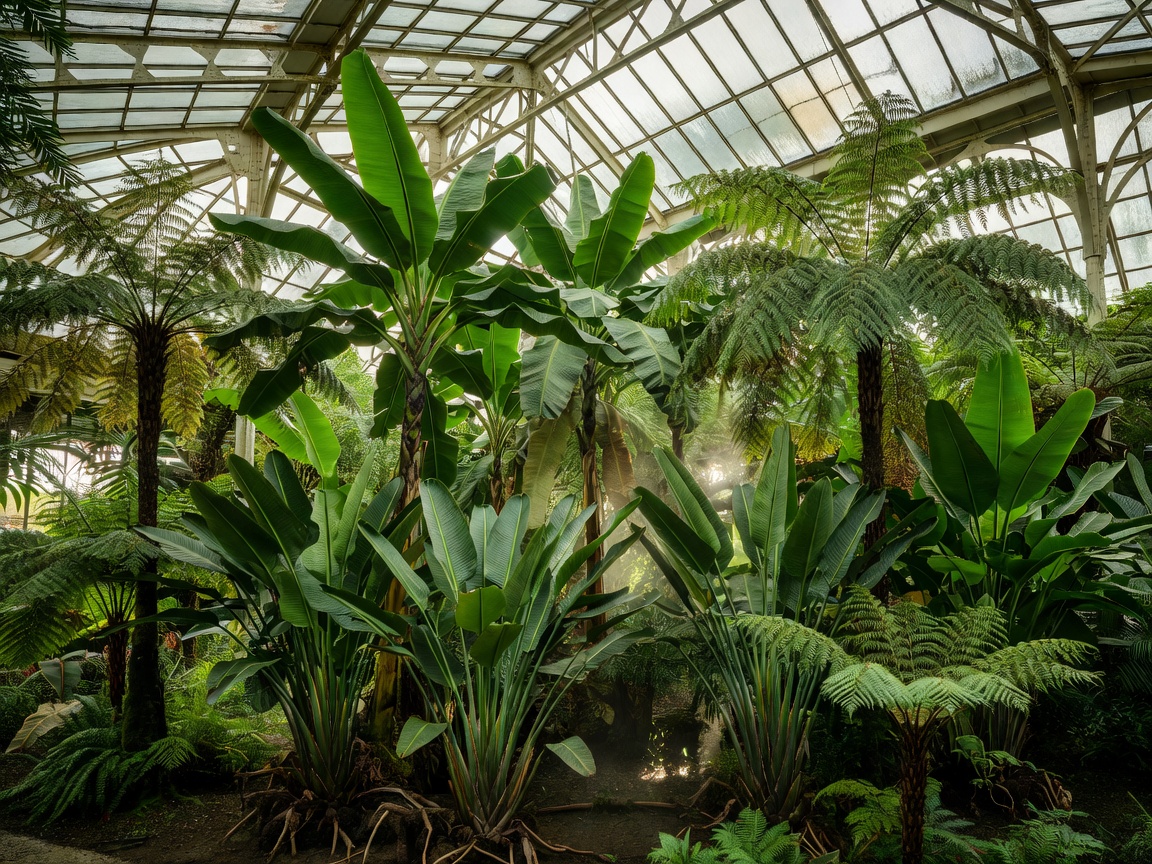
The connected glasshouse complex brings climates into Berlin that cannot persist outdoors through winter. Its visual centre is the Great Pavilion, historically known for its immense span and tropical planting. Around it, more specialised houses separate warm humid tropics, subtropical conditions, arid regions and particular plant groups. The sequence matters. A chain of houses can provide more precise environments than one undivided hall, although every doorway creates a place where heat and humidity may escape.
That segmentation also makes comparison easier. Broad leaves and drip tips are common in wet tropical displays, where shedding water and reaching light are persistent concerns. Succulents in dry houses store water in stems or leaves, reduce exposed surface area and protect tissues with spines, hairs or waxy coatings. The architecture of the plant becomes a climate record.
Find Welwitschia
Welwitschia mirabilis, native to the Namib Desert, produces a persistent pair of leaves that split and fray with age. It is one of the garden’s most instructive plants: strange in appearance, but closely fitted to an exceptionally arid environment.
How are different climates kept apart?
Each house balances heating, ventilation, shading, moisture and air circulation. Warm humid houses generally need higher minimum temperatures and carefully managed humidity. Arid houses demand bright light and much drier root conditions; excess winter moisture can be more damaging than cool air alone. Subtropical plants may benefit from a cooler seasonal rest. The labels “tropical” and “desert” are therefore starting points, not complete settings.
Connected structures create practical trade-offs. Shared services can make heating and maintenance more efficient, while internal doors and buffer areas reduce abrupt exchange between zones. Even so, solar gain shifts through the day and across the year. A glasshouse is full of microclimates: close to the glazing, beneath dense foliage, beside a vent or at the shaded foot of a tall specimen. Horticulturists place and move plants with those differences in mind.
What should we notice outdoors?
The geographic sections work best when we compare structure before chasing individual names. Look at canopy density, evergreen and deciduous habits, leaf size and the relationship between shrubs and ground-layer plants. In mountain sections, notice drainage and exposure. Rock placement is not merely decorative; it creates crevices, slopes and aspects that alter moisture and temperature around roots.
The arboretum adds time to the comparison. Trees reveal seasonal cycles and long-term form in a way that short-lived displays cannot. Bark, buds and branching remain informative when flowers are absent. If the glasshouses are a controlled compression of global climates, the outdoor garden is a slower negotiation between world floras and Berlin’s own weather.
How does Berlin compare with Kew and Paris?
Kew’s Palm House concentrates attention on a single celebrated structure and a tropical collection. Paris embeds glasshouses within a museum landscape shaped by classification and teaching. Berlin offers the clearest geographic journey of the three, moving repeatedly between region, habitat and controlled climate. Its breadth can be a challenge: trying to see everything usually turns meaningful differences into a blur.
A sensible route chooses one outdoor geographic area and two contrasting glasshouse zones. Check the garden’s official information for building access, temporary closures and accessibility before setting out. Inside, watch for condensation, vents, shade screens and changes in leaf texture. They reveal the same underlying story from opposite sides: plants respond to climate, and the building must respond to plants.