What is the Jardin des Plantes for?
The Jardin des Plantes began as a royal garden concerned with medicinal plants and developed into the principal botanical garden of France’s Muséum national d’Histoire naturelle. That institutional setting matters. The garden is not simply a green pause in Paris, although it certainly serves that role. It is a teaching landscape where living plants sit beside museum galleries, research collections and the long history of natural classification.
We can read that purpose in the organisation of the grounds. Formal axes create order at the largest scale. Specialist areas then separate questions: alpine plants, roses, ecological groupings and systematic relationships. The École de Botanique, or botany school, is especially revealing because its beds are arranged to help visitors consider plant classification. Names and family relationships become spatial. A path can function rather like a page, moving us from one group to another.
How do the Grandes Serres shape the story?
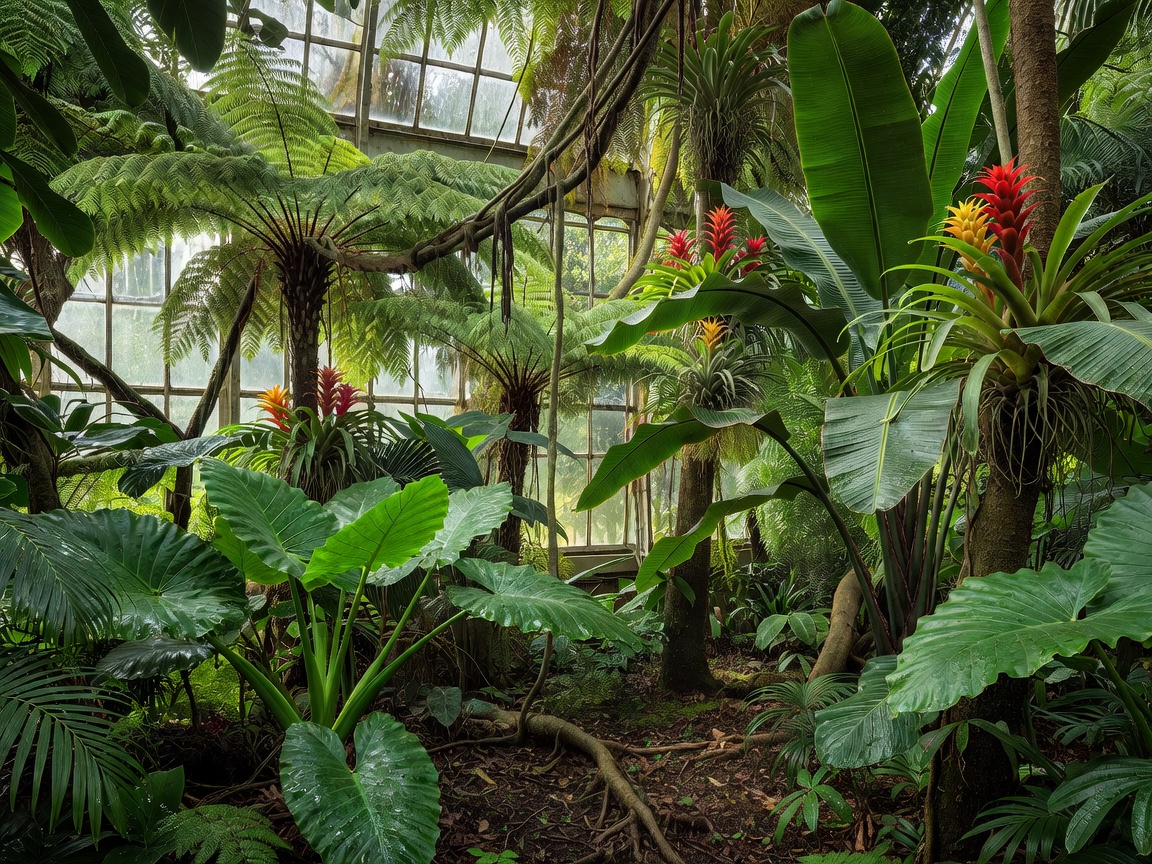
The Grandes Serres extend the garden beyond the climate of Paris. Their steel and glass volumes shelter tropical rainforest plants, plants associated with arid regions and material used to explain plant evolution. Each environment sets up a different rhythm. In humid tropical space, leaves overlap, vertical layers compete for light and water appears as atmosphere as much as irrigation. In dry displays, open ground and sculptural stems make individual adaptations easier to isolate.
This contrast helps us avoid treating “exotic plants” as one category. A rainforest understory herb and a cactus may both need protection from a Paris winter, but their requirements are nearly opposite. The first may depend on moisture, shade and relatively stable warmth. The second may tolerate intense light and drought while suffering in persistently wet compost. Glasshouse management is therefore a collection of local decisions, not one tropical thermostat.
Read the transitions
Doorways and connecting spaces are informative. Notice how glazing, shade, planting density and irrigation change as one climate gives way to another. The boundary reveals the work required to create the display.
How are climates controlled?
As at Kew and Berlin, the building starts with solar gain. Heating supports minimum temperatures in cold weather, while vents and doors release excess heat. Shading limits scorching and reduces the load on ventilation. Misting can raise humidity around foliage, but irrigation at the root zone still has to match each plant. Horticulturists also manage pruning, pest observation, nutrition and the replacement of growing media. A convincing scene rests on many unglamorous adjustments.
Paris presents an additional interpretive challenge: the houses receive many visitors while remaining plant environments. Paths need to carry people without compacting root zones. Views must stay open without forcing every plant into a theatrical shape. Labels must survive damp conditions and remain readable among large leaves. When a display succeeds, these controls recede and the planting feels abundant. We should not mistake that ease for an absence of labour.
What should we look for outside?
The systematic and ecological beds are essential companions to the glasshouses. Start by comparing repeated floral structures within a family rather than judging plants only by size or colour. Leaves may vary dramatically while flower anatomy suggests relationship. Botanical labels usually give a scientific name and family; those two lines turn casual resemblance into a question we can pursue.
The alpine garden offers another useful comparison. Here, small plants from mountains and cool regions are arranged with rocks, slopes and carefully drained soils. Their compact growth reflects exposure, short growing seasons and limited resources. Moving from these low cushions to a tropical glasshouse canopy makes climate legible through form. The lesson is not that one habitat is richer than another, but that plants solve different physical problems.
How does Paris differ from Kew or Eden?
Kew’s Palm House puts historic glasshouse engineering at the centre of the experience. Eden’s Biomes tell broad stories about ecosystems and human dependence on plants. The Jardin des Plantes feels more explicitly tied to the museum tradition of ordering knowledge. Its strongest visit combines indoor atmosphere with patient comparison outdoors and, where relevant, the neighbouring natural-history collections.
Before travelling, check the Muséum national d’Histoire naturelle’s official information for separate opening arrangements and access conditions across the site. Once there, resist trying to absorb every label. Choose one family, one climate contrast and one building detail. That modest thread often holds the garden together more clearly than a hurried inventory.