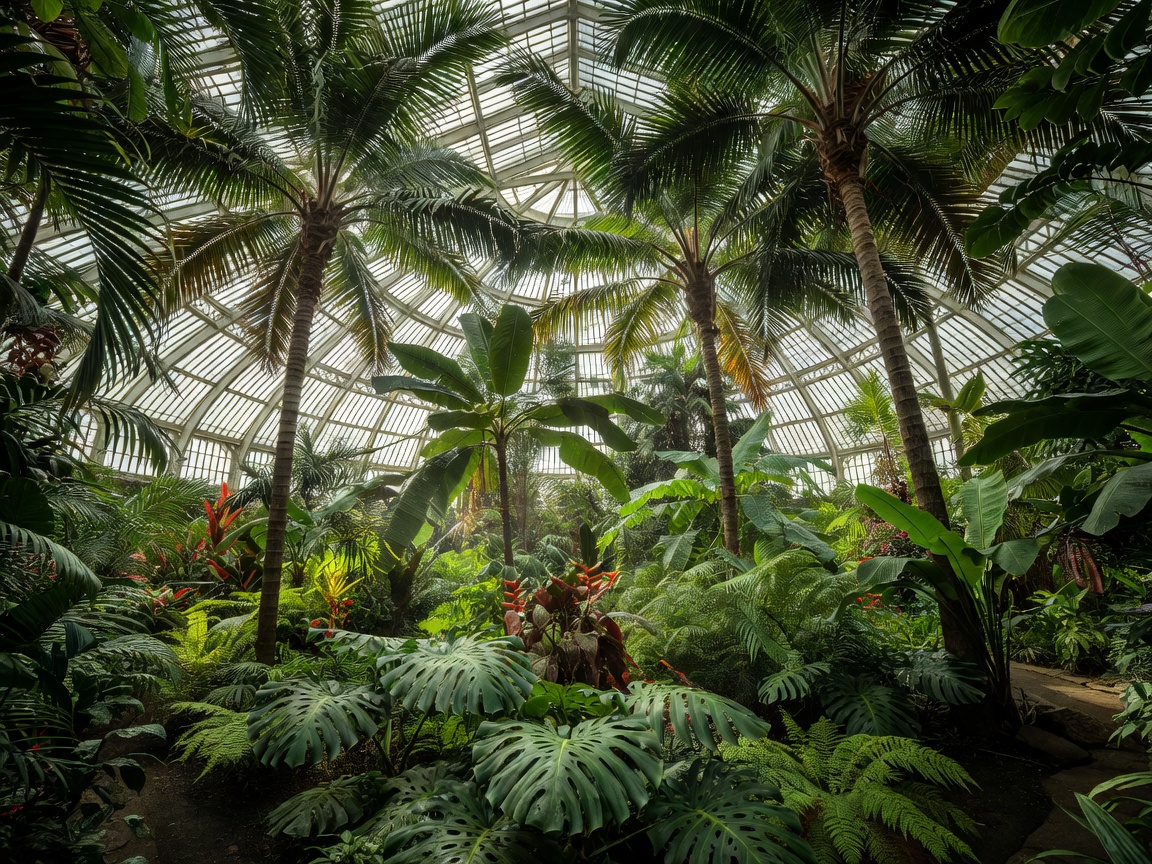
Why was the Palm House built?
Completed in the nineteenth century, Kew’s Palm House answered two ambitions at once. It provided the warm, humid conditions required by tropical plants, and it demonstrated what iron-and-glass construction could achieve. Architect Decimus Burton and iron founder Richard Turner produced a building whose curved ribs are often compared with an upturned ship’s hull. The comparison is useful rather than merely picturesque: shipbuilding knowledge helped make large, light iron structures possible.
The collection belongs to the Royal Botanic Gardens, Kew, where living plants support botanical research, conservation, identification and public education. Palms are prominent, as the name promises, but the house is not simply a decorative palm display. It brings together plants from tropical regions and makes their forms, uses and relationships available for study. Labels can lead us from familiar crops to threatened species and from ground-level foliage to a layered canopy.
How does a Victorian glasshouse hold a tropical climate?
Glass allows solar energy into the building, while the enclosure slows the loss of heat and moisture. That basic greenhouse effect is only the beginning. A large planted house needs heating during cold periods, ventilation when solar gain pushes temperatures too high, shading to reduce harsh light, and irrigation suited to plants with different root systems. Humidity matters, but stagnant saturated air can encourage disease. Air movement therefore sits beside warmth and moisture as a central part of management.
The Palm House’s historic fabric makes this balance unusually delicate. A modern sealed growing chamber can be designed around mechanical control; a listed Victorian structure must also preserve its architectural character. Metal, glazing, condensation, plant growth and visitor comfort all place demands on the same envelope. Major conservation work has periodically been necessary because warm, damp conditions that suit tropical plants are hard on ironwork. The house is not a static monument. It is maintained as working infrastructure.
Look upward, then downward
The upper walkway reveals crown shapes and leaf arrangements that disappear from floor level. Back below, exposed roots, stem bases, labels and changes in planting substrate show how the display is actually sustained.
What should we notice in the collection?
Begin with plant architecture. Palms grow from a single main growing point and do not branch like typical broad-leaved trees. Compare fan-shaped leaves with feather-like pinnate leaves, then look at how each crown occupies the limited volume beneath the roof. Nearby cycads may resemble palms at first glance, yet they belong to a very different and ancient seed-plant lineage. This visual resemblance is a good reminder that appearance alone does not establish relationship.
Next, look for economically significant tropical plants. Kew’s collections have long been entangled with the movement and study of useful plants, a history that includes both scientific exchange and the structures of empire. Rubber, oils, fibres, fruits and spices connect botanical specimens to trade and daily life. The labels and interpretation are most useful when they help us ask where a plant originated, how people have used it and why its wild relatives matter.
How does Kew compare with the other gardens?
Kew places a globally important institution inside an iconic piece of glasshouse engineering. Berlin-Dahlem offers a broader chain of connected climatic houses and strongly geographic outdoor displays. Padua’s historic garden begins from medicinal teaching and a remarkably persistent circular plan. Paris joins glasshouses to the taxonomic and historical collections of the Muséum national d’Histoire naturelle. Eden uses much newer biome-scale structures to tell an ecosystem story for a mass audience.
The Palm House is therefore best read at two scales. From outside, trace the repetition of slender ribs, curved glazing and central height. Inside, slow down and study how individual plants fit that inherited volume. The tension between exuberant growth and a precisely ordered frame is the heart of the place.
How can we plan a thoughtful visit?
Official Kew information should be checked for opening arrangements, access details and any temporary conservation work. Inside, changing temperature and humidity may feel demanding, so an unhurried circuit works better than racing through. Use the stairs only where appropriate to your access needs; much of the collection remains readable from ground level. Most importantly, leave time for labels. The building supplies the first astonishment, but the collection supplies the lasting argument.