What was Eden designed to do?
The Eden Project was created in a former china clay pit in Cornwall. That setting is part of its meaning. A heavily altered industrial landscape became the ground for gardens, education and ecological interpretation. The site does not pretend to be untouched nature; it shows landscape as something people damage, use, redesign and care for.
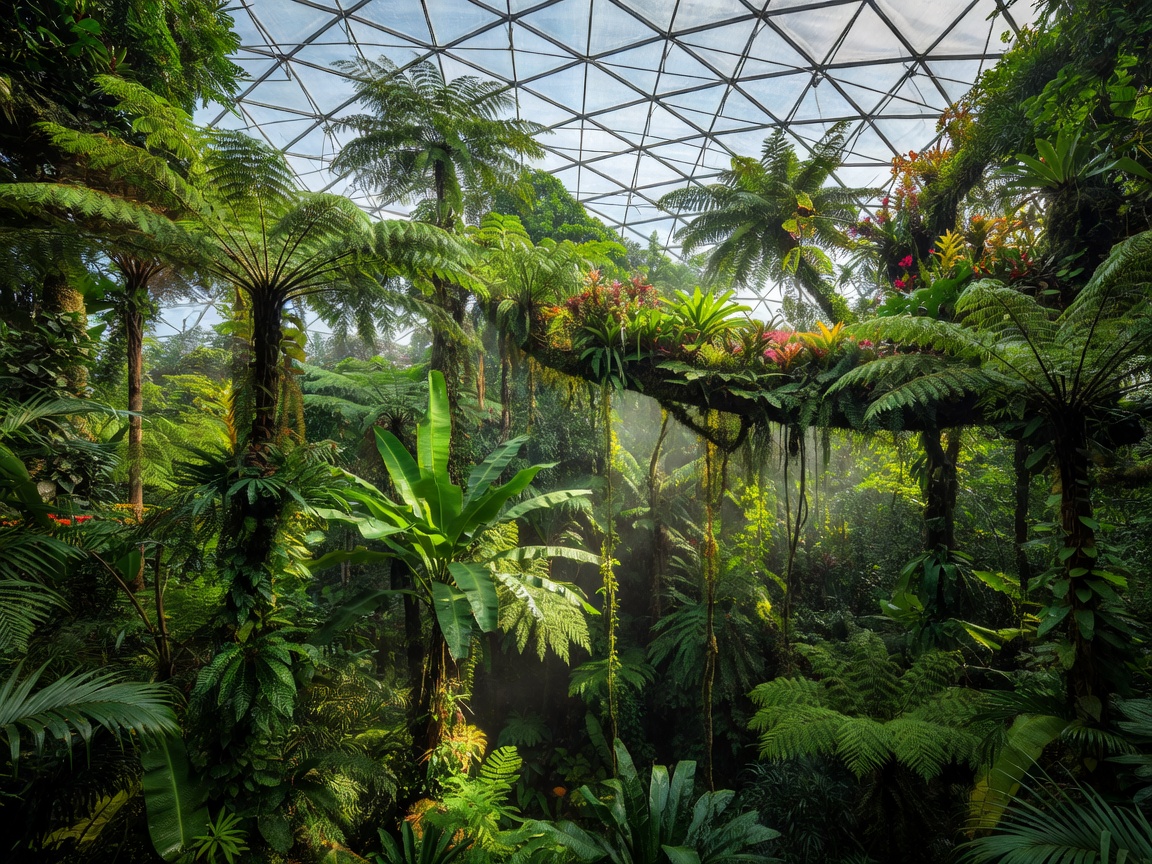
Its best-known structures are the linked Biomes formed from geodesic frameworks and inflated ETFE cushions. ETFE is a lightweight fluoropolymer that transmits light while placing less load on the frame than conventional panes of glass. The repeated hexagonal and pentagonal cells adapt to the irregular pit, allowing large enclosed volumes without a forest of internal columns. From outside, the Biomes resemble bubbles pressed into the slope. Inside, their scale supports mature planting and broad changes in elevation.
How does the Rainforest Biome work?
The Rainforest Biome creates warm, humid conditions for plants associated with tropical regions. Its height allows a layered canopy, while paths move from shaded lower planting towards elevated viewpoints. The collection includes plants connected with food, materials and livelihoods, so bananas, cacao, rubber and spices can be considered as parts of landscapes and trade systems rather than supermarket abstractions.
Warmth comes partly from solar gain, supported by environmental systems when needed. Ventilation limits excess heat, and misting and irrigation help sustain humidity and root moisture. The huge volume does not behave uniformly. Warm air rises, sunny slopes gain more heat, dense foliage traps moisture and paths create open corridors. Horticultural control works with these gradients instead of flattening them completely.
Watch the canopy layers
Look for tall framework trees, climbing plants, understory leaves and ground-level growth. A rainforest display becomes more informative when we read vertical competition for light rather than seeing one mass of green.
Why is the Mediterranean Biome different?
The Mediterranean Biome is warmer and drier than Cornwall outdoors but generally less humid and oppressive than the Rainforest Biome. Its planting draws on Mediterranean-climate regions, where summers are commonly dry and winters bring more rain. Similar seasonal patterns occur beyond the Mediterranean Basin, including parts of California, central Chile, South Africa and south-western Australia.
Plants respond with small, leathery, aromatic or silvered leaves that limit water loss and reflect intense light. Open spacing makes crowns and stems easier to see. Familiar crops—olives, vines and citrus among them—connect climate to cuisines and cultivated landscapes. Yet the display also shows a trade-off. Regions well suited to human settlement and agriculture can place intense pressure on highly diverse native vegetation.
How does Eden manage water and energy?
A large enclosed landscape needs substantial environmental control, but its form can reduce some demands. The ETFE cushion system is light and highly transparent, while the enclosure captures solar warmth. Rainwater management, drainage and irrigation are crucial in a pit where water naturally moves downhill. Plants are grouped by compatible needs, and control systems respond to conditions rather than maintaining one rigid number everywhere.
We should still resist treating any giant conservatory as climate-neutral. Materials, heating, pumping, maintenance and visitor transport all have impacts. Eden’s value lies partly in making such relationships discussable. The site frames sustainability as a set of choices and dependencies, not as a spotless label attached to a building.
How does Eden differ from a botanical garden?
Eden holds substantial plant collections and employs horticultural expertise, but its public emphasis differs from older botanical institutions. Kew, Berlin and Paris carry deep traditions of taxonomy, preserved collections and formal scientific research. Padua’s identity begins with university teaching and medicinal plants. Eden leads with ecosystem interpretation, public engagement and the relationship between people and the living world.
That difference changes how we read labels. A traditional botanical display may foreground scientific name, family, origin and accession. Eden often builds a narrative around use, habitat or environmental consequence. Neither method is automatically better. Scientific precision prevents the story becoming vague; strong interpretation prevents the plant becoming a name detached from life.
What should we prioritise?
Allow time for the transition between the Rainforest and Mediterranean Biomes. Changes in moisture, light, scent, leaf texture and planting density carry the main comparison. Notice the structural cells overhead and how their scale changes with the terrain. Look back towards the outdoor gardens as well: the planted pit is as important to Eden’s argument as the enclosed climates.
Check Eden’s official information for access, opening arrangements and any heat-related guidance. The Rainforest Biome can feel physically demanding for some visitors, and elevated routes may have separate conditions. A slower route is no loss. Eden is clearest when we connect one crop to its climate, one building choice to its consequence and one spectacular view to the systems keeping it alive.